Carolina Wetlands Association gets help from the NC National Guard
We work better together to create a walkable watershed in Dunn, NC.
The Stony Run Walkable Watershed project in Dunn, NC will be getting assistance from the NC National Guard’s 105 Engineer Battalion. The first phase of the project has been funded by a planning grant from the NC Land and Water Fund.
The goals of this project are to:
- Increase community understanding on flood reduction and benefits of enhanced ecological function to support future growth.
- Provide a healthy stream corridor with native vegetation that can also improve water quality.
- Support community goals of expanding public access to outdoor spaces and recreational trails.
- Increase community involvement in planning to reduce flooding issues and improve access.
The Carolina Wetlands Association has identified restoration of the original floodplain and de-channelizing the stream below the dam as a key step to reducing flooding, and improving the health of the stream corridor. In addition, the project will provide public access via addition of a path, a fishing platform and parking. Restoration of the floodplain will enable it to provide its natural service, a location where flooding stream water can slow down, spread out and be stored for later absorption. Floodplains are also a productive environment for plants and wildlife.
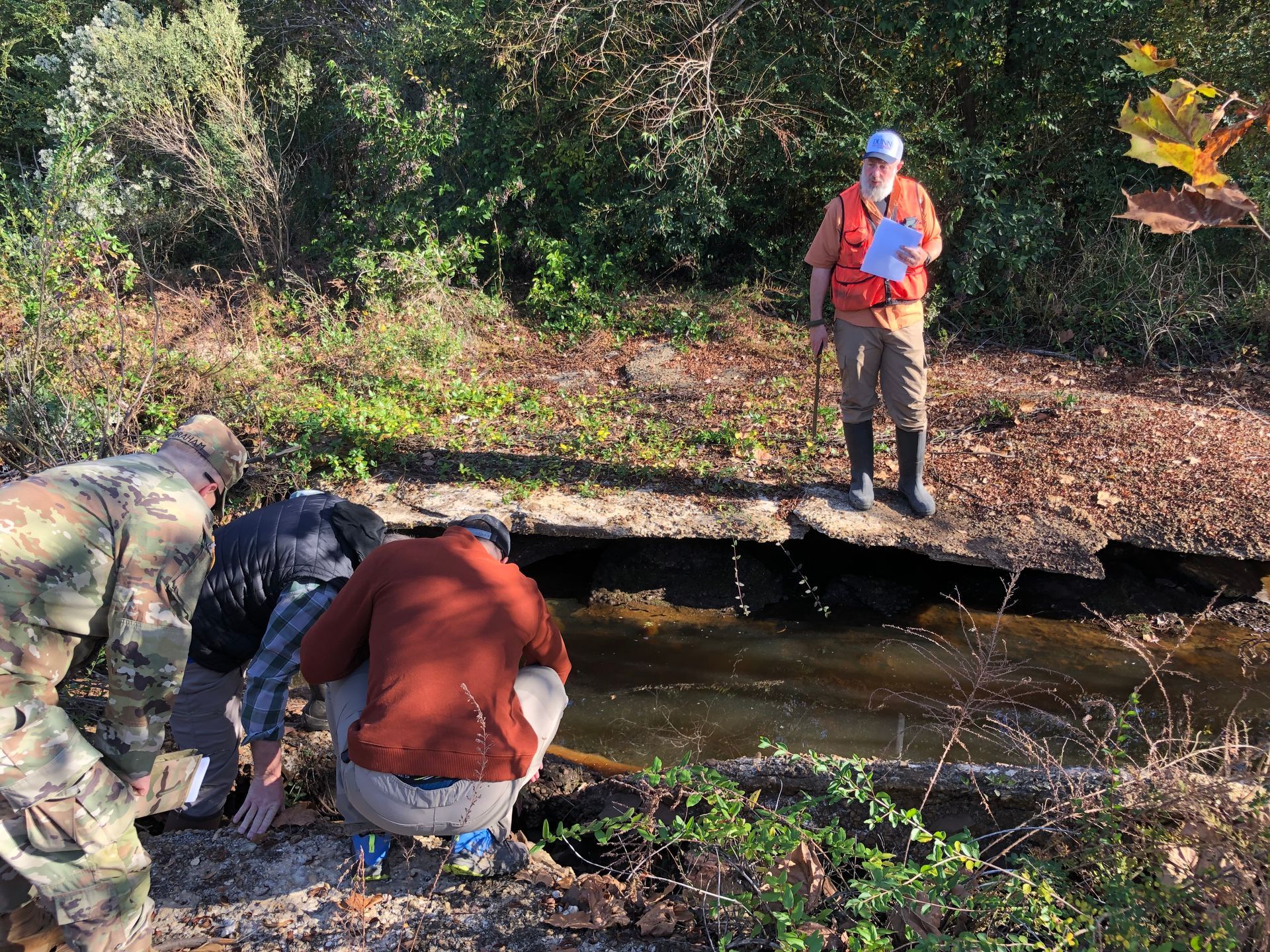
The 105 Engineer Battalion expressed an interest in helping the project to combine their training with community service and environmental restoration. Major Erin Graham and Captain Ryan Baldwin visited the site late November 2023 to determine how they might assist the project. Battalion surveyors will conduct a detailed survey of the project area in January 2024 to document changes in elevation across the site, collect information needed to identify the rough boundary of the floodplain and procure the necessary permits. The Battalion also plans to dig soil pits to help determine the depth of fill material that will need to be removed from the floodplain to uncover the wetland soils. Finally, the Battalion will aid in the removal of the fill material.
The 105 Engineer Battalion’s assistance will greatly support our efforts to restore the floodplain. Their surveying of the site will allow us to begin designing the restoration without delay, as opposed to needing to wait for additional funding. In addition, the sum total of their assistance will greatly reduce the cost of the project. We are grateful that they approached us about assisting our project.
You might also like
Celebrating Our Carolina Wetlands